Monday, January 11, 2010

Living Your Life With More élan

By Alexander Jarman, Public Programs Manager
This coming Tuesday, January 12, the Museum has another installment of its exciting Art of Élan concert series-it’s chamber music with a heck of a lot of energy. I asked Art of Élan’s two artistic directors, Kate Hatmaker and Demarre McGill, if they could answer a few questions about their group, classical music and working with the Museum.


1. Tell us a little about how you decided on the name Art of Élan.
First, we love the word élan. It’s a French word that represents spirit, vitality and momentum, all of which have universal appeal. For us, Art of Élan is really about the art of living your life with more élan. It’s about injecting some élan into all that you do, and for us, that’s classical music.

2. You are both already professional musicians playing in a highly regarded symphony. What made you want to decide to start a side project?
We formed Art of Élan a little over 3 years ago, with the intention of attracting a more diverse audience to classical music. There is often a misconception that classical music is somehow outdated, that young people are unable to relate to it today, but we both feel that live ‘classical music’ is extremely relevant and exciting. We felt that we… would be able to showcase the local talent of San Diego [and] make classical music more accessible for people in San Diego.

3. Who do you enjoy listening to?
While we both listen to a wide variety of music (pop, hip-hop, classical, jazz, blues) we are usually struck by people who are trying to do something different with their art.

4. Why did you specifically want to work with the Museum for this series?
We are so thrilled to be collaborating with SDMA on this year’s “Fantasia” series. Performing in an art gallery allows people’s senses to be stimulated much more than they would at traditional concert halls, and, as each of our concerts is inspired by a different work of art in the museum’s collection, there is certain synergy that pervades the events, uniquely marrying both music and visual art. It’s an added bonus that the Hibben Gallery has such nice acoustics as well!

5. What can we expect from this next concert on Tuesday?
Our upcoming concert is called “Shades of Affection.” Inspired by Pablo Picasso’s Painter and Model III, it features a wide variety of musical tellings of love and lust. We have also invited a bass/guitar duo from Tijuana to come perform some of their original compositions on the program. The entire show will be available online by Wednesday afternoon (www.instantencore.com/artofelan), so that concertgoers can continue to enjoy the concert experience, long after it’s over!
As with all of our concerts, we invite our guests to join us afterwards for Happy Hour food and drinks, next door at The Prado.

We're not the only ones interested in Art of Élan. Check out the article in this past Sunday's Union-Tribune with the link below.
http://www.signonsandiego.com/news/2010/jan/10/art-elan-gives-classical-music-fresh-young-face/

Concert details:
Tuesday, January 12, 7:00 p.m.
Hibben Gallery
Members: $20, Nonmembers $25, Students $10
Above image: Pablo Picasso

Spain, 1881–1973
Painter and Model III, 1970
Pastel on card
Gift of Mr. and Mrs. Norton S. Walbridge
1991:18

Tuesday, January 5, 2010

The Never-ending Revision of Collections Research

A number of my earlier blog posts have given some idea of the never-ending (but nonetheless rewarding) task of research on the permanent collection. Here's another episode in "the life of a painting," showing how stories and misinformation can gradually accrete on the canvas.

The portrait at left is by the Nabi artist Pierre Bonnard (1867-1947) and hangs in one of the small upstairs galleries with the rest of the collection given to the Museum by Ambassdor and Mrs. Maxwell Gluck.  Executed in the broad, flat patches of color and thick brushstrokes typical of Bonnard’s work, the painting has always been identified as a portrait of a “Monsieur Monteux.”

At some point in the late 1960s or early 1970s, before the painting came to the Museum, the title evolved. Whereas before it was simply identified as "Monsieur Monteux," suddenly it became a "Portrait of Pierre Monteux."

This is a case of wishful thinking. Someone must have asked, "Who was this Monteux?"  ...and then found the most famous Monteux possible: Pierre Monteux (1875-1964), one of the great conductors of the early 20th century. He had been the conductor for Diaghilev's Ballets Russes in Paris in the early 1910s but left Europe at the outbreak of World War I and came to America, where he was later conductor of the Boston Symphony Orchestra and the San Francisco Symphony Orchestra.

Moreover, the sitter in the portrait bears some resemblance to Pierre Monteux. Here, at right, is a photograph of him published in Life magazine in 1950. 
But the problem is this: Bonnard's painting was made much, much earlier... at least 35 years before that photograph, to be precise. If a portrait of Pierre Monteux, Bonnard's canvas would have had to be painted by 1915, when Monteux left France, but the conductor was only then 34 years old, and the sitter in the portrait is a much older man. The Bonnard catalogue raisonne, moreover, dates the painting to ca. 1915, presumably on the basis of style.

So if not Pierre Monteux, who is it? There is another Monteux who seems to fit. Marcel Monteux, the owner of the Chaussures Raoul chain (the first mass-produced shoe chain in France), was an early patron of the so-called Nabi group of artists, which included Bonnard and his associates Edouard Vuillard, Maurice Denis, and Ker-Xavier Roussel. Roussel's decorative paintings for the Monteux house, for example, are today in the Dayton Art Institute. Marcel Monteux also owned works by Degas and other leading artists of the day. If Bonnard painted a portrait of an older Monsieur Monteux in 1915, Marcel Monteux would seem to be our man. Unfortunately, there do not seem to be any other portraits or photographs of Marcel Monteux to compare, so for now (at least), the painting remains simply a "Portrait of Monsieur Monteux," but at least we've got Pierre out of the picture, so to speak.

-John Marciari, Curator of European Art
(with thanks to Agnes Penot-Lejeune for her help with provenance research)

Meet a Gallery Member!

This is my first stab at this so I welcome feedback! I'm a volunteer on the SDMA's steering committee for The Gallery and my focus is membership. I thought the group would be much more fun if we could start to learn a little about each other - even if it is only completely random, trivial facts!

My guinea pig was Antoinette Lipman (pictured below with fellow Gallery member, Sam Dychter) she eagerly answered my questions so that at our next Gallery event everyone would have a few random conversation starters with her (or so I would stop asking her to do this for me). ~ Kim

Here we go -

What do you think San Diego's best kept secret is? The view from Clay's Restaurant.
Guilty pleasure? Watching old Alfred Hitchcock shows on Hulu.

Swim, bike, run or gym? Tennis.

Favorite restaurant in San Diego? Harry's Diner.

Thing you are most excited to learn/do/experience with the Gallery? I am really excited to get a look behind the scenes at the museum.
Craziest place you have ever been OR the place you would most like to visit? I'd like to go see the Northern Lights and also take a road trip to do my own taste of the best hamburgers and BBQ across the country.

Tuesday, December 15, 2009

Gallery Palette: An Interview about Exhibition Wall Color


By Alexander Jarman, Public Programs Manager


The Museum has installed a lot of exhibitions in the past year and each one of them came with a fresh coat of paint.  Wall color is an important component of our gallery spaces- it has the power to enhance works of art or detract from them.  To learn a bit more about this matter, I asked the Museum’s own Andrew Marino and John Marciari (Museum Technician and European Curator respectively) as well as Joshua Rectenwald, the Painters Assistant at the Cincinnati Art Museum to share their insights about the colors we see in art museums. 
To start us off, what are some of your favorite or least favorite colors you have used in your museum?
JM:  My favorites are Raisin Torte in Gallery 17, Pumpkin Blush in Gallery 20 and Cork in Gallery 18 and 16. The color we used for the Picasso, Miró, Calder exhibition reads as much more blue than I expected when looking at the samples.  It’s vital to pick colors under gallery lighting-there are HUGE variations when they’re seen in the fluorescent/incandescent lighting of the offices, for example.
AM: I know this seems like a cop out, but I think the colors we choose are all successful.  Color choices for exhibits endure a lengthy decision process before they are selected.  I trust this process.  Some colors sing with the art a little better than others, but that’s life.
How much does wall color affect an exhibition?
AM: Ideally, it shouldn’t affect it at all.  Practically, it helps support a sense of cohesion.  Exhibition wall colors can also help the viewer organize information and make connections.
JR: Wall color can have drastic affects on exhibitions.  In general, paint determines the overall mood of the gallery space.  Lighter colors present a more casual and lively environment while darker colors tend to create a more solemn and serious experience.  Color can also be used to break up different sections of an exhibit, thus clarifying and making it easier to navigate.
JM: I think the wall color affects an exhibition quite a bit…or more accurately, things like wall color and lighting affect people’s perception of an exhibition.  The pictures are the pictures, but I do think there are better and worse ways of seeing them. 
What else should we know about painting the walls of a Museum?
AM: Clean up sucks.  Paint buckets, brushes, rollers, various utensils, etc.  It’s not necessarily difficult work, just time consuming.
JR: My favorite part of the installation process is actually peeling and scraping all the vinyl off the wall.  It feels like I’m erasing the former exhibition. But if there was one thing I would say about paint colors it would be that no one sees eye to eye on them.  I get this all the time when I’m painting a gallery.  I’ll have people ask for the name of the paint and tell me that they really like the color, and then the other half I talk to think that the color choice looks terrible.  So I guess you can’t win.

Tuesday, December 1, 2009

California Cool

Although it's right there in the lobby when you enter the museum, some of our visitors miss the rotating Collections in Context installation. The principal of the installation is simple: every few months we choose a newly acquired object—something that has entered the collection by gift or by purchase within the past six months—and we hang it alongside an object (or a group of objects) that has been at SDMA for a number of years. By offering a context in which to test visual relationships between new acquisitions and objects long-held by the Museum, Collections in Context presents the daily practice of museum work to visitors.
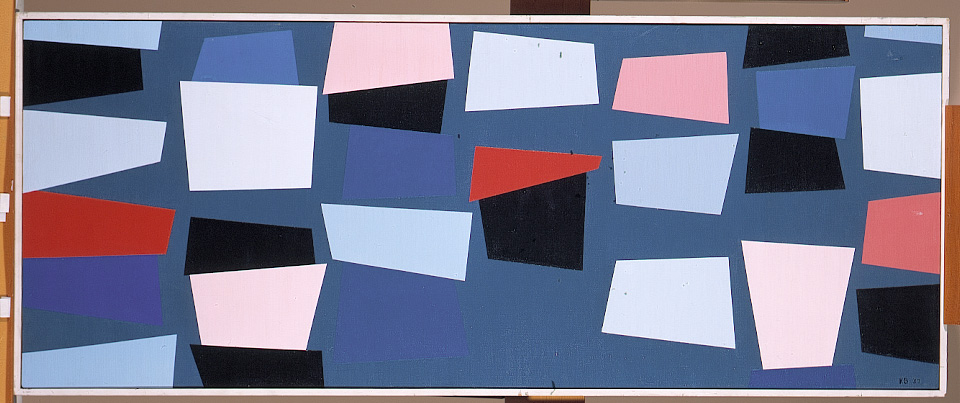
Last week, we reinstalled the latest installment, which focuses on the recently acquired Balls, #16, painted in 1964 by Oskar Fischinger (1900-1967).


Fischinger, who had fled his native Germany with the Nazi rise to power, settled in California in the late 1930s. He is best known as a filmmaker, and particularly for his pioneering works in an abstract, non-figurative mode. In Hollywood, he attracted the attention of Orson Welles and assisted with Walt Disney’s Fantasia. He nonetheless continued to have difficulties in finding an audience for non-figurative films, and during the last two decades of his life devoted himself to painting, pursuing the types of abstraction he employed previously in his films.

Fischinger's geometric paintings find many parallels in the work of other California-based artists of the time, among them Karl Stanley Benjamin. In 1959, Los Angeles Times art critic Jules Langsner coined the term “Hard-Edge Painting” to describe the work of these California painters. Partly a reaction against Abstract Expressionism, Hard-Edge Painting emphasized angular lines, reduced forms, precise surfaces, and rich colors.

In the current installation, we've paired Fischinger's painting with an untitled work by Karl Benjamin, which was painted in 1957 and acquired by the Museum of Art in 1958.


Finally, Colorforms in Colorspace #12, a painting of 1948 by John Sennhauser, rounds out the installation. Sennhauser was based in New York when he painted the canvas, but he later settled in Escondido, and this is one of a group of his works that came to the Museum of Art after his death.


In all, it's a miniature of exhibition of just three works, but one that really encapsulates the aesthetic of mid-century Modernism in California and beyond.

Wednesday, November 25, 2009

The Art of Collecting: Event Wrap Up

On November 12 Members of The Gallery met up in La Jolla for The Art of Collecting.

Owners Joseph Bellows and Ron Stevenson did a fantastic job of welcoming guests to their galleries and "back rooms" for private viewings of their art storage and presentation areas.

This experience sparked a new dialogue for several collectors who took the opportunity to explore works currently NOT on view, by artists they are interested in learning more about.


Post tour, guests noshed on more fine food (and imbibed in more fine wine) before embarking on a lively discussion with John Marciari , Curator for European Art and Katy McDonald, Deputy Director for External Affairs. The conversation generated a host of questions from "can you negotiate a deal?" to "how do you know the dealer is reputable?" to "what should you buy?".

Number one, buy what you love--and visit Museums and galleries to learn and determine what it is that moves you. Marciari responded to questions on reputation and trust, indicating that you should ask other collectors and other gallery owners for feedback, if a certain dealer seems questionable. Look for dealers with a solid history. On this, and negotiations for price, Bellows implored the importance of viewing the process as a "relationship" and not as a "transaction".


On the question of forgeries and fakes, Marciari encouraged everyone to have confidence in their quest for more information--"don't be afraid to reach out to a specialist in the area of art you are passionate about."

Finally, sign up for gallery mailing lists to receive invitations to opening events. Visiting local galleries is an important part of your art education and one of the many ways to support artists in our community.

Thursday, November 19, 2009

Discovering Rosalba Carriera


Here’s a story about one of the “new” works on view in the recently reinstalled European Art gallery at the Museum.

A few months ago, one of our registrars came to my office and handed me a quick index photograph (there it is at left) she’d just taken of a work that turned up during an inventory of one of the store rooms. The work, attributed to Rosalba Carriera, was acquired in 1949 but no one could recall ever having seen it on public view.

My first thought: Wow. That looks like the real thing.

Rosalba Carriera was one of the most highly-sought portraitists in eighteenth-century Italy, second in popularity only to Pompeo Batoni (whose portrait of Etienne-Reneé Potier de Gesvres hangs in the recently reinstalled gallery). Rosalba’s particular specialty was the portrait in pastels, and she had few equals in that medium. The portrait of a woman had all the benchmarks of her style, and having been little-exhibited, it seemed – even in the photograph – remarkably fresh. Rosalba is a special artist; the Getty has just acquired a pastel portrait by her.

But then I had my second thought: Oh no. The Frame.

The frame is unmistakably that of the royal collection in Dresden. Once you’ve seen a group of them, you can’t miss them. And the problem with the frame was that at the outbreak of World War II, the Dresden collections were dispersed for safekeeping, and many works never made it back to the museum when the war ended. The Dresden Museum has a major provenance research project underway in an effort to locate all the looted treasures.

Born and trained in Italy, Rosalba had spent years working at the court in Dresden, and the largest collection of her pastel portraits is in the museum there. This seemed to be a vote in favor of the San Diego portrait’s authenticity. The bad news, though, is that I was afraid that just as we’d rediscovered a great work, we might have to send it back to Dresden.

So let the research begin: I quickly discovered in our curatorial files that the dealer who sold us the work wrote in 1948 that he got it through an “exchange with the Dresden Museum, about 18 years ago.” (The dealer was Jacob Heimann, of New York and Los Angeles – and if anyone has more information about him, please let me know). I’ll admit I was deeply skeptical.

I went back to the old catalogues of the Dresden collection. The 1899 and 1905 catalogues list 156 pastels, but only 109 are in the catalogues published since 1929, with no reference to the missing 47.

At this point, I wrote to Andreas Henning, the Curator in Dresden. I explained that I was doing “a bit of research on Rosalba, and that I was curious about the pastels missing from later editions of their catalogue.” (This was a bit evasive, I’ll admit it.) Andreas explained that yes, some of the Rosalba pastels had been missing since before the war, but earlier in the century, Dresden’s then-director Hans Posse “exchanged” some with dealers in an attempt to acquire contemporary art.

We then went through the old catalogue lists, and we found one pastel described as a “Portrait nearly front view, dark grey background. Brown eyes; flowers in the gray hair; brown, multicolored flowered dress with a décolletée. The right hand at the breast.” This seemed to match. It was number 88 in the old catalogue, and it had been sold back in 1924 in exchange of a painting by Wilhelm Trübner.

At this point, I went back into storage and opened up the frame. There, on the back of the old stretcher supporting the pastel, was a most welcome sight: the number 88. Case closed. Not only had we confirmed its provenance, we’d also established that it had been sold by Dresden, and that we would not have to send it back.

And it’s now on the wall in San Diego, for the first time in decades. But pastels are delicate, and after a few months, we’ll return it to a nice dark corner of the storeroom to preserve it.
Come see it while you have the chance.

John Marciari
Curator of European Art
Head of Provenance Research